Category: Art Groups

  • Brushing 永字八法 The Eight Principles of Eternal

    Brushing 永字八法 The Eight Principles of Eternal

    As we moved into Spring at our monthly shodō groups, we worked on a classic character and practiced its strokes and styles. We brushed 永 ei, meaning eternal, which has been written for centuries for its balance of eight strokes central to learning calligraphy, known as 永字八法 (えいじはっぽう eiji happō), the Eight Principles of Eternal. The character is visually made up of two streams merging together, continuously flowing, and this is where the meaning of eternal originates from ✨

    Brushing 永字八法 The Eight Strokes of Eternal

    As we had just a single character, we had more time to look at examples from calligraphers and brush and compare 永 ei in three styles, the kaisho regular, gyōsho semi cursive as well as sōsho fully cursive ‘grass’ style.

    Brushing 永字八法 The Eight Strokes of Eternal

    Here is a humorous Spring themed haiku by Edo period poet Kobayashi Issa, that Blair shared with participants:

    The spring breeze.

    Being pulled by a cow

    To the Zenkoji temple.

    It was an amiable group at KSD in Glasgow with a pleasant atmosphere of peaceful concentration whilst participants worked away on their stroke practice and brushed eternal in the inspiring styles of the masters. This time we brushed on shikishi calligraphy boards as well as hanshi calligraphy paper, noticing the difference in the feel and ink spread of both. Many thanks to everyone for taking part and we look forward to catch up with you again next time.

  • Haiga Events: a Harmony of Japanese Painting and Haiku Poetry

    Haiga Events: a Harmony of Japanese Painting and Haiku Poetry

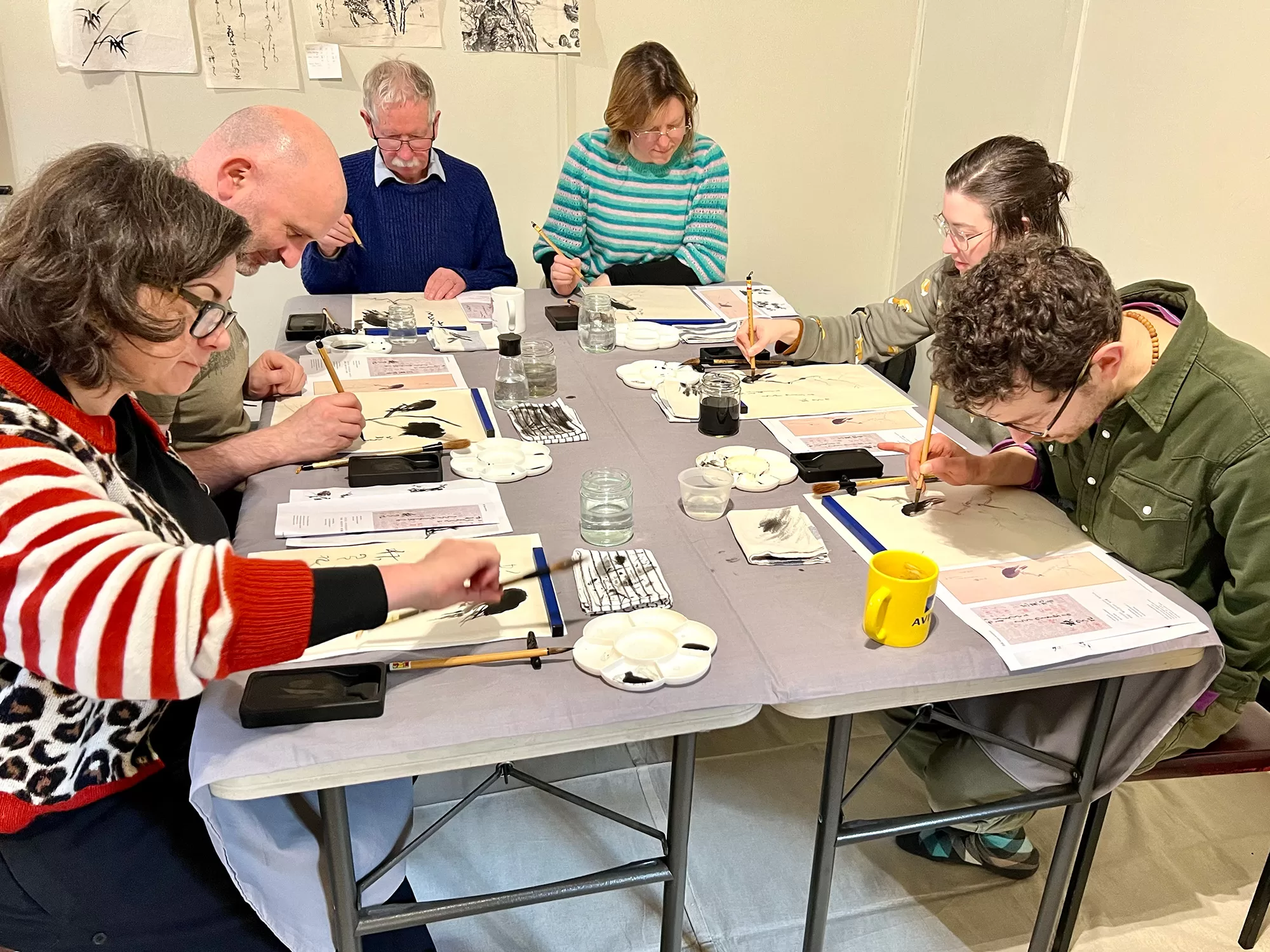
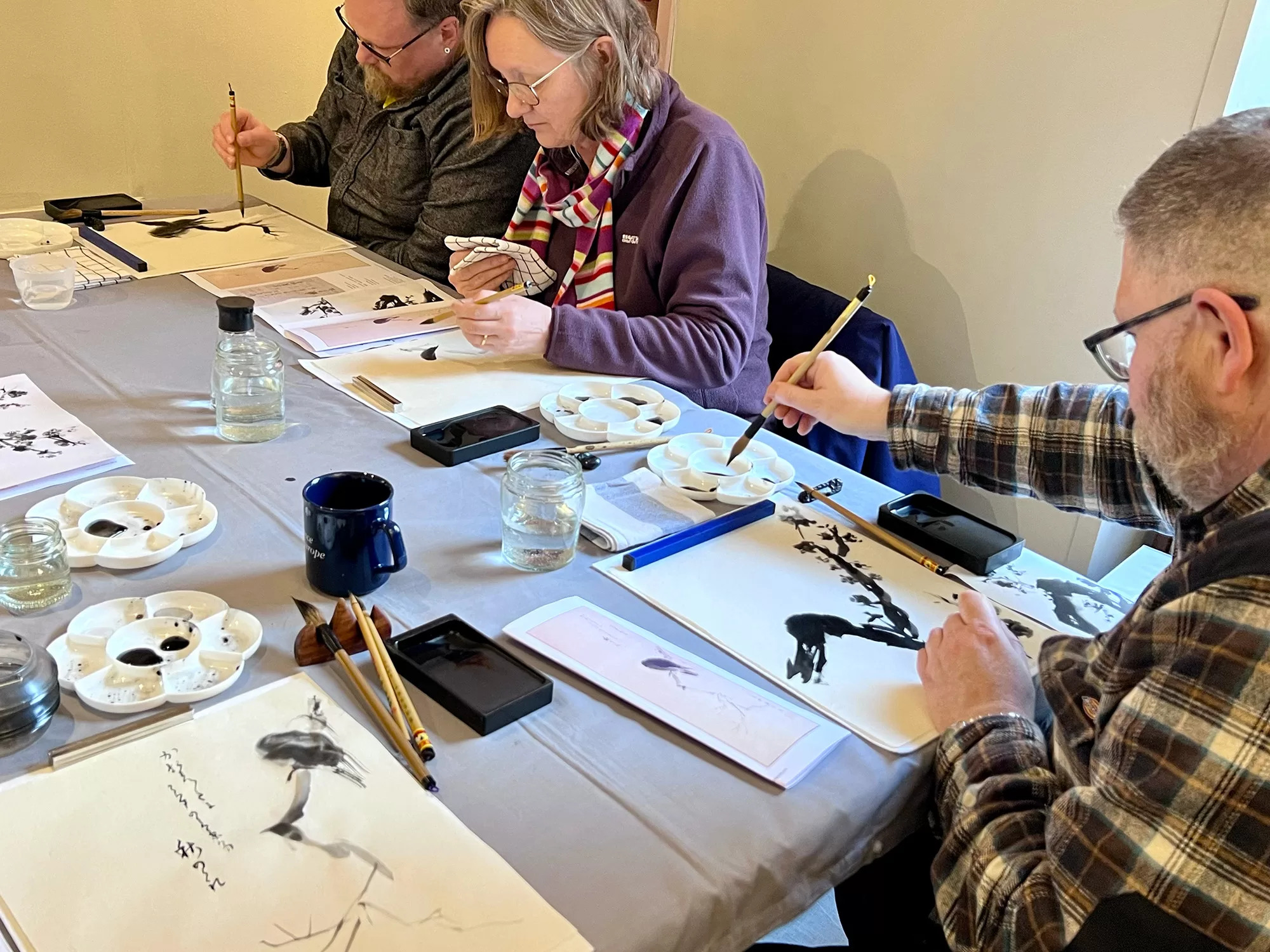
    In February we led two workshops introducing and exploring Haiga 俳画 a harmony of Japanese painting, and haiku poetry brushed in calligraphy. These events were held in the Glasgow area of Scotland, and were kindly sponsored by The Great Britain Sasakawa Foundation, allowing participants to experience the traditional methods and ideas that inform Haiga. The workshops took place in Charing Cross (Kagyu Samye Dzong Tibetan Buddhist Centre) as well as Maryhill Hub (with North United Communities) for adults and also young people from the communities.

    Haiga Events: a Harmony of Japanese Painting and Haiku Poetry

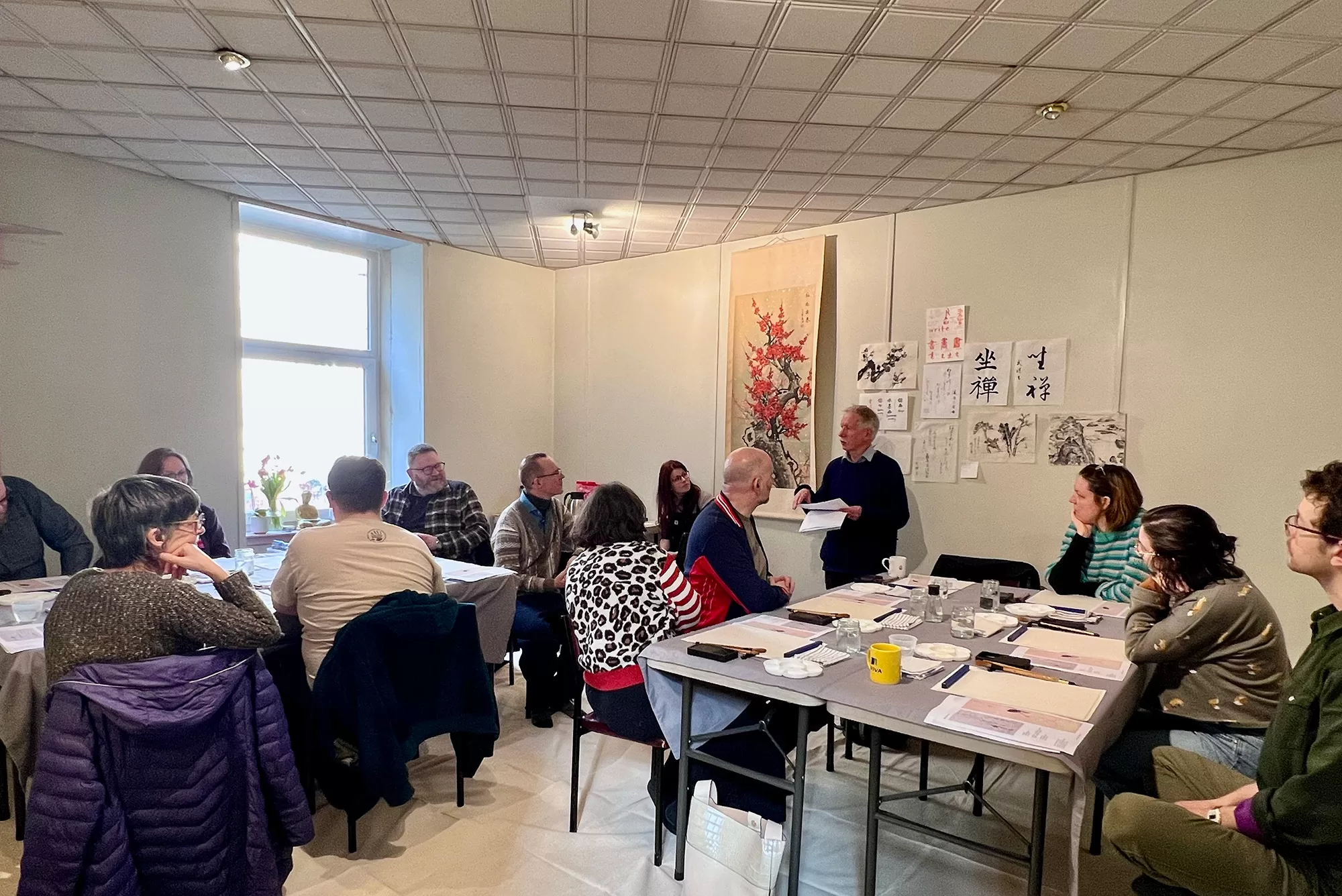
    Artist and calligrapher Blair led the events with the help of a fabulous team and including a special contribution by haiku poet Dr Kenneth Mullen. Firstly, Blair introduced the haiga practice which is little known in the United Kingdom, with examples of pictorial styles, brushwork and calligraphic techniques along with a brief history of haiga.

    Haiga Events: a Harmony of Japanese Painting and Haiku Poetry

    He also talked about his experience visiting esteemed teachers in Japan in December 2024 to January 2025, investigating the traditional relationship between inscribed text with painted image in Zen and Japanese culture, and the combination of poetry brushed in kana calligraphy and other styles with suibokuga (also known as sumi-e) painting. Kenneth helpfully illuminated the understanding of haiku for participants, unravelling the structure, techniques and meanings of Basho’s classic poem of the crow on the withered branch, which participants worked from.

    The workshops helped people connect with their environment through the brushwork and poetic themes of haiga, discover the differences between brushwork in Japanese suibokuga painting and Japanese kana calligraphy, and through these approaches develop appreciation of the environment and landscape painting from a uniquely Japanese perspective. The meditative and immersive way of working helped participants relax and enjoy the process.

    There was a great sense of achievement and surprise as participants became more confident with the way of working and completed their pieces. There ended up some very different types of inky crows perching on branches, from cheeky and cute to wise and serene! The younger group were also confident to try out some bold brushwork, particularly of the plum blossoms, as well as birds and animals and their own experimental haiga too!

    Thanks so much to everyone who took part as well as those who supported the events and helped out. Deepest thanks to The Great Britain Sasakawa Foundation for making the events possible and supporting the project.

  • Brushing Hakuin’s vision in shodō calligraphy

    Brushing Hakuin’s vision in shodō calligraphy

    Inspired by Edo period Zen monk Hakuin Zenji’s writing and natural imagery, at our monthly shodō calligraphy online group and relaxed in person meeting at KSD Glasgow we wrote 風清 kaze kiyoshi, pure wind, following the words 月白, (bright) white moon.

    Brushing Hakuin’s vision in shodō calligraphy

    It was a nice atmosphere at the group, being relaxed and also lively at times, and everyone did well to get a feel for the characters, and enjoy the calligraphy techniques, even with kaze which has a range of strokes 🌬️

    Brushing Hakuin’s vision in shodō calligraphy

    The phrase is from Hakuin Egaku’s 槐安国語 Kaiankokugo 1749. 月白風清‘White moon, pure wind’ which expresses an open and accepting attitude that doesn’t hold grudges. The experience of seeing the bright moon or feeling the cool breeze on your skin, and being refreshed, can pull us back into momentary awareness which can, if we’re open to it, remind us that we don’t need to be swayed by emotions, cravings and aversions. At our online group we brushed the four kanji characters together, and looked at examples by 20th century calligraphers.

    We brushed in both the kaisho regular as well as sōsho cursive ‘grass’ style. As we worked, it was blustery outside. Here is a short, windy haiku by Matsuo Basho for this season:

    wintry wind –

    passing a man

    with a swollen face

    Thanks to everyone for taking part!

  • The white moon of Hakuin in varied shodō styles

    The white moon of Hakuin in varied shodō styles

    At our recent shodō groups in person and online we brushed the striking kanji characters Tsuki shiro 月白 (つきしろ)🌙, meaning bright white moon, from a commentary by Zen master Hakuin Zenji written in 1749.

    The white moon of Hakuin in varied shodō styles

    This is part of a longer phrase ‘white moon pure wind’ which has been brushed by Zen calligraphers. The spirit of ‘white moon pure wind’ is not holding grudges, accepting and enjoying things as they are.

    We brushed the two kanji characters in both the kaisho standard script and the sōsho fully cursive style, with contrasting thickness of strokes in each kanji. At the classes we tried to capture the shape of the moon as we wrote it, inspired by the old shell and bone as well as tensho (seal) scripts.

    The white moon of Hakuin in varied shodō styles
    The white moon of Hakuin in varied shodō styles

    This time the relationship between the kaisho and sōsho styles was as clear as the white moon we were brushing, and the participants enjoyed the loose and relaxed feel of brushing in the sōsho style.

    At Zen Brush online class we had some extra time to explore more contemporary calligraphic styles and for Blair to talk through different ways of working with the materials.

    Here is a short, relaxing moon haiku by Matsuo Basho that befits the mood of the classes:

    From time to time
    The clouds give rest
    To the moon-beholders.

    It was great to see everyone really focussed on brushing, thanks for joining!

    Participants' shodo gallery
  • Season’s Greetings

    Season’s Greetings

    We hope you are keeping cosy and looking forward to the winter break. Here is our Season’s Greetings card, a sketch of rock strata made on the spot at Oshima Island, south of Tokyo, using brush pens and sketchbook.

    Season's Greetings 2024 Drawing and Painting Studio

    Please have a peek at some colourful images from our groups and community events (click ‘D+P Studio News’ below), it has been a super duper creative year!

    Deepest thanks for all your participation and generous support this year and we look forward to catch up with you again very soon in 2025, the year of the hebi (snake) which we hope will be peaceful one.

    With warm and joyful wishes,

    Blair and the D+P Studio team 🙏

  • Brushing 秋の空 Autumn Sky

    Brushing 秋の空 Autumn Sky

    Towards the end of Autumn at shodō calligraphy we brushed the nature inspired and seasonal Aki no sora 秋の空 (あきのそら), meaning Autumn sky 🍂

    Brushing 秋の空 Autumn Sky

    We practiced the two kanji characters with the Japanese kana の in between, writing them in two vertical columns for the kaisho and one vertical line with the characters together for the sōsho fully cursive style.

    Brushing 秋の空 Autumn Sky

    The participants enjoyed brushing the sōsho in a single column and with a demonstration and guidance by Blair were able to find the 中心 chūshin vertical centre line and balance as well as feeling of space on the paper ✨

    Brushing 秋の空 Autumn Sky
    Brushing 秋の空 Autumn Sky
    Brushing 秋の空 Autumn Sky

    Here is a short haiku poem for us heading into the winter season, by Shiki:

    面白や かさなりあふて 雪の傘
    Omoshiro ya
    Kasanari oute
    Yuki no kasa

    It’s interesting –
    Lying upon each other,
    Umbrellas in the snow

    Thanks to everyone for taking part!

  • An Autumnal Afternoon Exploring Shodō Classics

    An Autumnal Afternoon Exploring Shodō Classics

    As golden leaves fell in the Woodlands area of Glasgow, our first afternoon Shodō group at KSD was likewise inspired by the ochre earth and expansive heavens, brushing from the magnificent Thousand Character Classic Senjimon 千字文. The afternoon was enjoyable, immersive and educational, split into two parts with a lovely group of curious participants and a friendly atmosphere.

    The first part included an introduction to Shodō and the text, and the three styles we worked from, learning about the history of Japanese and Chinese calligraphy in the process. Blair introduced the famed calligraphers 王羲之 Ogishi, 懐素 Kaiso and 松本 芳翠 Matsumoto Hōsui Sensei, also looking at physical examples of Japanese shodō works.

    After getting the feel for how to hold the fude brush, posture, and the traditional materials, we then spent some time on practicing individual kaisho strokes. We mainly concentrated on working from classic stylistic examples of the kaisho standard script (with 4 characters), gyōsho semi cursive (6 characters) and sōsho fully cursive (6 characters) styles, from Blair’s otehon examples and worksheets, with the techniques and methods he has been trained in over the years in Japan.

    Participants learned how to handle ōfude and kofude brushes and find harmony between thickness of ink, types of calligraphy paper, and also understand how to position and size characters effectively with a suitable amount of space for the rakkan signature and stamp area.

    At the break we had time for hōjicha Japanese tea and daifuku sweets, and some dark chocolate kept us energised too!

    As well as working from the classic styles held in high esteem by Japanese calligraphy schools, we spent some time exploring a meditative approach, and brushed some enso Zen circles, immersing ourselves in the sensory aspect of the practice. Towards the end we enjoyed some free time brushing on shikishi gold edged calligraphy boards, which rounded off the afternoon nicely.

    For more about the Senjimon classic, see our previous posts, and visit this link for a translation.

    http://www.camcc.org/_media/reading-group/qianziwen-en.pdf

  • Heartful Zen Calligraphy for Autumn

    Heartful Zen Calligraphy for Autumn

    Moving into autumn we had a theme of empathy with the heartful Zen phrase dōji 同事 (どうじ), which has a meaning of thinking about others, and their heart. As a common Japanese word it simply means ‘the same’ ✨

    In the kaisho style the two characters are noticeably different in their overall shapes and thicknesses of strokes, yet combine very naturally in the sōsho ‘grass’ style. So there was quite a contrast between the styles this month.

    We had time to practice these varied strokes and enjoy embracing the joining strokes in the cursive style, which participants delighted in the flowing, connected feeling of brushing. We also looked briefly at the semi cursive style. It was a relaxed group with some Japanese hōjicha (roasted brown tea) and tasty mochi rice cakes to keep us energised 🫖🍡

    It was difficult to find a poem that followed our theme! Here is a poem by Issa about an encounter and a small act of compassion:

    A Radish Worker
    With the radish he 
    Pulls out, a radish-worker
    Shows the road to me.

    Issa

    Thanks to everyone for taking part, and to those for sharing some pictures here of their calligraphy practice and a fascinating ukiyo-e artwork of Edo period calligraphy practice.

    A Children’s Calligraphy Gathering (Yōdō sekigaki kai) by Utagawa Kuniyoshi
    歌川国芳「幼童席書会」
    A Children’s Calligraphy Gathering (Yōdō sekigaki kai) by Utagawa Kuniyoshi
    歌川国芳「幼童席書会」
    Woodblock print (nishiki-e), ink and colour on paper; around 1842 (Tenpō 13)
  • Calligraphic simplicity brushing tsuyu 露

    Calligraphic simplicity brushing tsuyu 露

    After the summer break our Saturday morning class in Glasgow and our online Monday evening group met to relaxingly ease back into shodo calligraphy practice. Brushing the single character for dew or open air, Tsuyu 露, which in Zen writings has also had a meaning of impermanence and natural change ✨

    Beginning with some tips on holding the fude and practicing some of the main strokes in this kanji, we then copied the kaisho standard style and the flowing sōsho style. We also had some time to look at the semi cursive style and the flow of the stroke order.

    In all these styles the character is basically made up of three parts, which were dynamic to brush in balance. Our challenge was to convey the sense of the heavy rain cloud in the top part of the kanji! We had some inspiration from some Zen fully cursive calligraphy for this 🌧️

    The dew and openness themed poem below by master Dōgen includes the word tsuyu and captures the impermanence and spontaneity of life, which participants enjoyed brushing 🙂

    Mujō – Impermanence

    To what shall
    I liken the world?
    Moonlight, reflected
    In dewdrops,
    Shaken from a crane’s bill

    (translated by Heine)

    Thanks to everyone for taking part again, and to those for sharing some pictures here of their calligraphy practice.

  • Natural Inspiration and Bold Tenkoku Seal Engravings

    Natural Inspiration and Bold Tenkoku Seal Engravings

    At our June Japanese Tenkoku stamp making workshop we had a lively group of enthusiastic carvers and busy stampers! This was a full afternoon session creating unique seals from scratch – forgive the Tenkoku pun! Everyone was able to cover the essential techniques of this age old East Asian craft, complete their seal and feel the excitement when making their own inei 印影 impression on Japanese calligraphy paper.

    Blair talked about the history of Tenkoku 篆刻, showing physical examples of stamps used by his teachers in Japan and detailing the traditional tools and materials. He then helped guide each participant with their individual design, choosing kanji to match their names or fascinating visual or literary ideas and interests, and advising in how to work in the inten or tensho stamp making styles.

    We could tell it was an energetic and experimental session by the amount of activity and materials on the work tables! Thanks to the participants for making the group a fabulous afternoon and we hope you will delight in stamping with your own seal, and come up with more ideas for future stamp designs.

    Well done to engage so deeply in the Tenkoku tradition, completing such a variety of excellent designs, from names related to boats and water to heavenly gardens and imagery of flowers and people. Thanks to participants for sharing some of their images from the afternoon.

    Thanks to participant Elaine (https://www.instagram.com/scottishpolishlass/) for kindly providing fantastic photos!